Livestock Risk Protection (LRP) insurance for cattle producers + feeders


What is LRP Insurance?
LRP provides cattle producers protection from declining national cattle market indexes, giving producers an alternative method for managing downside price risk on their livestock.
Why do cattle producers use LRP?
All cattle producers face the risk of declining market prices
LRP is Smart: The USDA’s Risk Management Agency (RMA) subsidizes premiums 35–55%, often making it more affordable than other risk management hedging tools. Also, LRP coverage still allows producers to capture market moves to the upside.
LRP is Simple + Affordable: LPR starts with a one-time application to establish your eligibility but doesn't lock in any coverage on its own. Once approved, you place a Specific Coverage Endorsement (SCE) each time you want to actually bind coverage, selecting your target weight, coverage level, and insurance period to match your marketing plan. LRP policyholders are not subject to margin calls.
Why EastCo Group?
We're cattle producers who are LRP experts
We use LRP ourselves: We understand the importance of protecting your livestock against declining markets in all sectors of the cattle industry from cow-calf to finishing at the feedyard. We have experience using futures and options, and understand when and why it is optimal to use LRP as part of your risk management plan. We can help maximize risk management and basis value for your operation.
What to expect in a loss
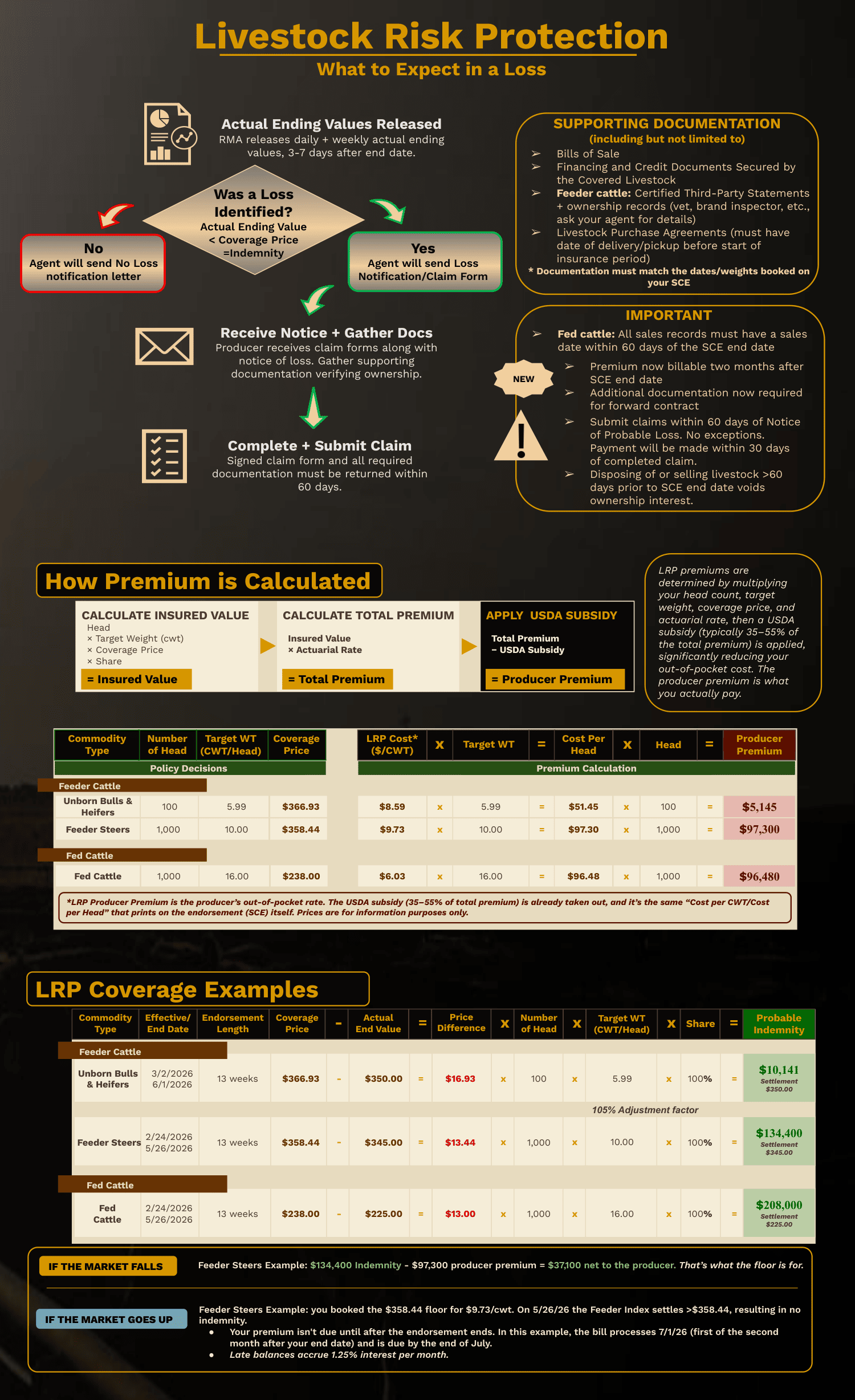
Forms will be sent to you by your agent.
The RMA will release daily and weekly actual ending values 3–7 days after the SEC end date. If the actual ending value is less than the coverage price, an indemnity is owed. Your agent will send loss notification and claim forms to you. Once you receive these forms, gather supporting documentation verifying ownership. Signed claim forms and all required documentation must be returned within 60 days.
You will need to gather your supporting documents.
Supporting documents include (but are not limited to) the following:
- Bills of Sale
- Financing and Credit Documents Secured by the Covered Livestock
- Feeder cattle: Certified Third-Party Statements + ownership records (vet, brand inspector, etc., ask your agent for details)
- Livestock Purchase Agreements (must have date of delivery/pickup before start of insurance period)
Documentation needs to match what you booked for your SCE (dates + weights)
***Fed cattle: All sales records must have a sales date within 60 days of the SCE end date ***
- Premium is now billable two months after the SCE end date.
- Additional documentation is now required for forward contract.
- Submit claims within 60 days of Notice of Probable Loss. No exceptions. Payment will be made within 30 days of completion. Disposing of or selling livestock >60 days prior to SCE end date voids ownership interest.
Coverage Decisions
Type of Cattle
Fed Cattle: 1,000–1,800 lbs finishing weight for Steers + Heifers
Feeder Cattle Weight 1: < 600 lbs end weight
Price Adjustments:
- Steers = 110%
- Heifers = 100%
- Brahman = 100%
Feeder Cattle Weight 2: 600–1,000 lbs end weight
Price Adjustments:
- Steers = 100%
- Heifers = 90%
- Brahman = 90%
Unborn Bulls + Heifers
Price Adjustments = 105%
Coverage Level
- 70–89% = 45–55% subsidy
- 90–94% = 40% subsidy
- 95–100% = 35% subsidy
Endorsement Length
- 13–52 Weeks
Number of Head
- 1–12,000 head/endorsement
- Up to 25,000 head/year
A Coverage Example
In this hypothetical policy for 1,000 head of feeder steers, let's assume that you have an endorsement length of 13 weeks, target weight of 10 cwt, and a coverage price of $358.44. At the end of your SCE, the RMA releases an actual ending value of $345. First, subtract from your coverage price ($358.44) the actual end value ($345). This will give you a price difference of $14.44. Multiply this by 1,000, the number of head insured in this example, times the target weight of 10 cwt per head. Finally, multiply this by your share. If you have a 100% share, this would equal a probable indemnity of $14,440.
Determining Premium
LRP premiums are determined by multiplying your head count, target weight, coverage price, and actuarial rate, then a USDA subsidy (typically 35–55% of the total premium) is applied, significantly reducing your out-of-pocket cost. The producer premium is what you actually pay.
LRP Timeline
- Fill out an application at any point during the year: An application must be filled out to establish eligibility.
- On most days the Chicago Mercantile Exchange (CME) board is open: An SCE can be submitted to establish coverage for livestock between ~2:00 PM MST and 7:25 AM MST the next morning. Please Note: LRP sales will NOT be available on Cattle on Feed report Fridays.
- Ongoing: Keep records to prove ownership of cattle covered under a SCE.
Special Note: The RMA can limit or completely shut down LRP availability due to high market volatility or other unforeseen circumstances.
This material is for informational purposes only and does not constitute an offer to sell insurance. No coverage, policy change, addition, or deletion is effective unless confirmed by a licensed insurance agent. Proposals are based on the values and risks you disclose and are subject to the final policy’s terms, conditions, and exclusions. Federal crop insurance is reinsured by the FCIC and governed by USDA RMA rules. Final eligibility, coverage, and indemnity depend on accurate reporting and program compliance. Coverage varies by election and may not be available in all states. If viewed in a state where EastCo Group, LLC is not licensed, the content is for informational purposes only. Clients should consult a licensed agent for guidance. While efforts have been made to ensure the accuracy of this material, EastCo Group, LLC makes no express or implied warranties and expressly disclaims all liability for any errors, omissions, or reliance on this information. EastCo Group, LLC is not responsible for any direct, indirect, or consequential damages resulting from its use.